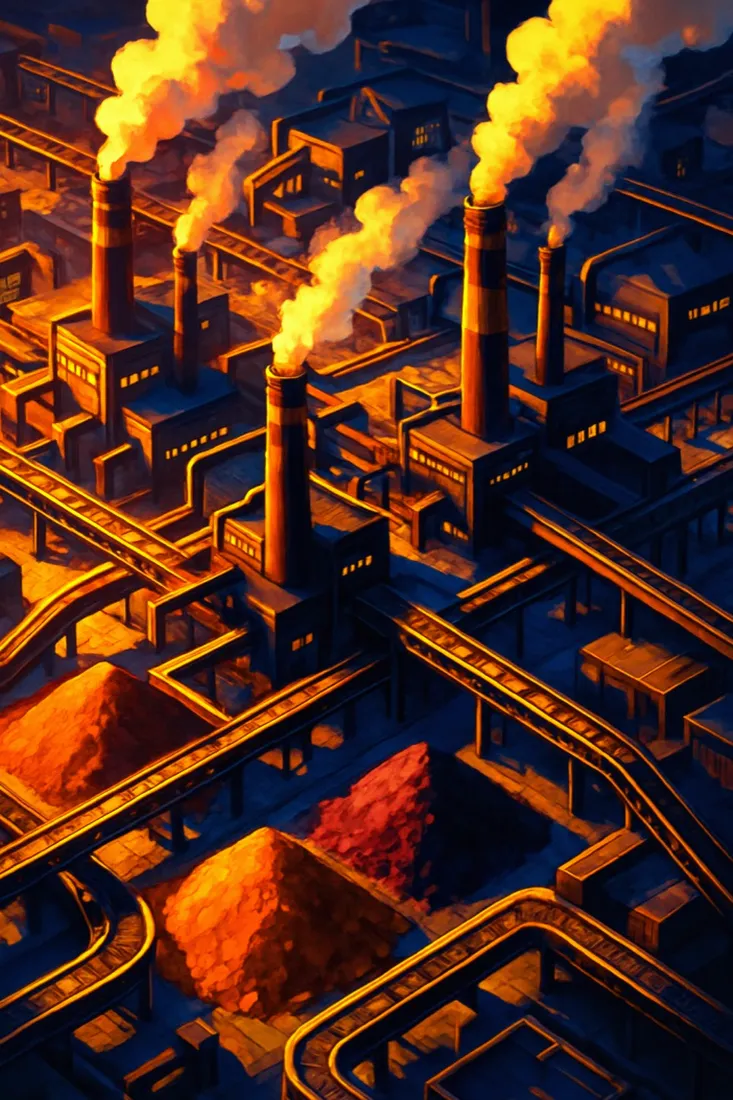
Most games on this shelf ask for an account before you have seen a single building. Industry Idle asks for nothing. You open the page, the game loads, and you are placing your first extractor within a minute. The developer’s own pitch is simple: try it in your browser with no registration required. For a tycoon game, that frictionless start is a small revolution.
We played it for three weeks in the gaps of a busy schedule: on lunch breaks, while the kettle boiled, during the last ten minutes before bed. It suited that rhythm beautifully. Industry Idle is an idle game, but it is a thoughtful one, closer to a factory designer that keeps working while you are elsewhere.
Tiles, routes and the satisfying hum of a supply line
Your base sits on a grid of tiles. You place buildings that extract raw materials, others that process them, and you route resources between them so that each step of a production chain stays supplied. The challenge is balance: one slow building starves everything downstream, and one over-productive one piles up goods you cannot use. Spotting and fixing those imbalances is the game’s central pleasure.
It scratches the same itch as the heavier factory games on PC, but in a much smaller, friendlier package. You will not spend hours untangling conveyor spaghetti. Instead you make a few precise changes, watch the numbers settle and move on. The layout matters enough to feel strategic, yet never so much that a mistake ruins an evening.
Trading goods with players around the world
What lifts Industry Idle above most idle games is its market. Goods you produce can be traded with players around the world through the game’s trading server, which means the value of your output is not simply a number someone wrote in a spreadsheet. It depends on what other factories are making and what they need.
In practice that adds a pleasant layer of judgement. Should you specialise in something the market lacks, or keep your production self-sufficient and ignore trading altogether? We tried both approaches and found that dipping into the market at the right moments sped things up noticeably. It is optional, though, and a purely solo factory is perfectly viable if you prefer to keep to yourself.
Offline earnings and the art of the restart
As an idle game, Industry Idle keeps producing while you are away, so coming back after a working day means a stockpile of goods to spend. That turns every session into a small planning meeting: what has piled up, where is the bottleneck, what should I build next? It is a very calm loop, and one that respects your time.
The prestige system adds the long game. At certain points you can restart in exchange for permanent benefits that unlock more powerful upgrades. Each new run goes faster than the last, and the knowledge you carry forward makes the early layouts quicker and cleaner. It is the classic incremental structure, done well, and it gives the game far more staying power than its simple first impressions suggest.
An open book, and a game that travels with you
Industry Idle has an unusual distinction: its source code is publicly available, published under an open licence, and the developer invites community contributions. Translations are handled by the community too. For players, that openness signals a project run with a light, transparent touch, and it is reassuring in a genre that is often heavy on aggressive monetisation.
The game also exists on Steam and on mobile, and the developer says progress can be moved between platforms. That makes the browser version an excellent place to start: try it at your desk, and if it clicks, you can carry the same factory onto your phone. We found ourselves checking production on the train home more often than we would like to admit.
Seven days to settle into Industry Idle
- Start in the browser with no account and play for an evening before deciding whether to register.
- Build one simple production chain end to end before expanding in several directions at once.
- Watch for the slowest building in each chain and upgrade or duplicate it first.
- Check the player market for goods you produce in surplus, and sell them when prices look healthy.
- Read up on the prestige system before your first restart so you know what carries forward.
What we love
- No registration at all means you can be building within a minute of arriving.
- Balancing production chains on a tile grid is precise, calm and genuinely satisfying.
- A live player market makes your output feel valuable rather than abstract.
- Offline production means short, irregular sessions still lead to real progress.
What grates
- The interface is functional rather than pretty and can feel cluttered at first.
- Early runs can feel slow until the prestige system starts paying off.
- There is little in the way of story or characters to warm the numbers.
Who will love Industry Idle
Industry Idle is for tinkerers with busy lives: people who enjoy designing efficient systems but only have ten minutes here and there. If you like factory games but dread their time demands, this is the gentlest way into the genre.
Our call on Industry Idle
Industry Idle is the most respectful game in the yard. It asks for no account, it keeps working while you are away, and it hides real depth in its production chains, player market and prestige runs. It is plain to look at and slow to start, but few browser games reward short sessions so generously. A quiet triumph.